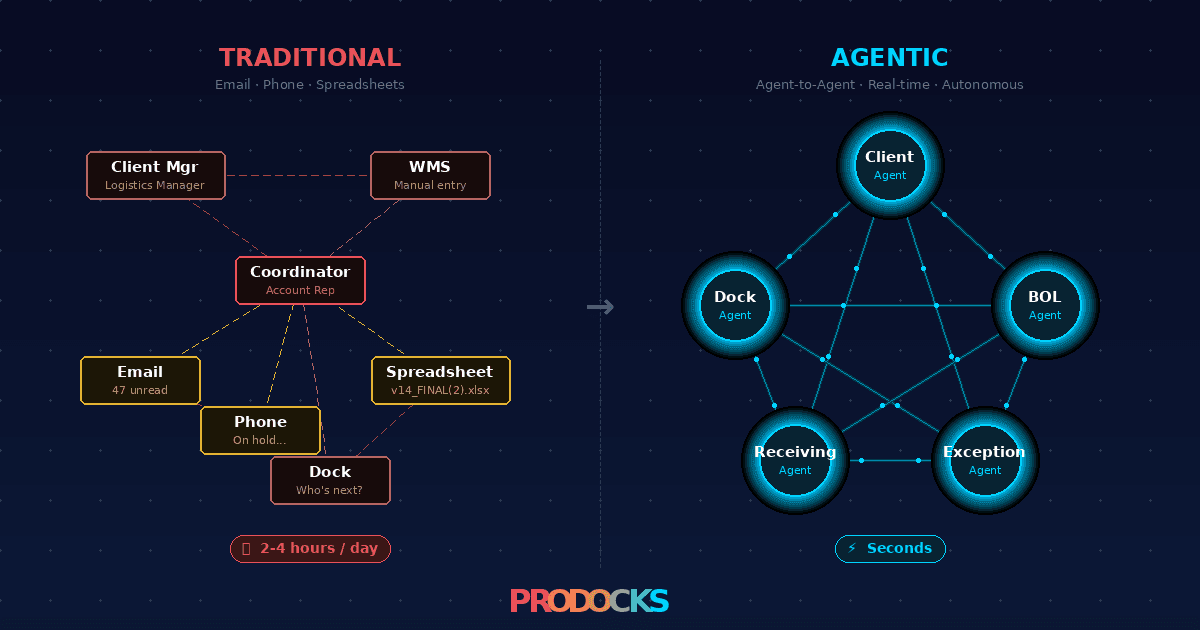
Here's what a typical Monday morning looks like for a dock coordinator at a mid-sized 3PL: 23 unread emails about inbound appointments. A client's logistics manager needs to reschedule two containers. A carrier is calling about which dock door to use. Friday's receiving discrepancy still hasn't been resolved — the photos are buried in an email thread with four people CC'd. And somewhere in a filing cabinet, three BOLs are waiting to be reconciled against POs that live in a completely different system.
The coordinator toggles between the WMS, a shared spreadsheet, the dock scheduling tool, and email — manually relaying information between systems and people who can't talk to each other directly. By 10 AM, they've handled a dozen threads and moved zero pallets.
This isn't a staffing problem. It's an architecture problem. And the three workflows at the center of it — dock scheduling, BOL processing, and receiving exception handling — are about to change.
The emergence of agentic AI — AI systems that don't just answer questions but autonomously plan and execute multi-step tasks — is creating a new model for dock operations. Instead of a client's logistics manager emailing a 3PL account coordinator about an inbound shipment, a client agent will communicate directly with a dock operations agent, handling routine workflows in seconds and escalating to humans only when judgment is needed.
This article maps the three dock workflows that consume the most coordinator time — appointment scheduling, BOL validation, and receiving exceptions — and shows how each one transforms in an agentic future. We'll also lay out the practical path to get there, including technologies you can use today.
The Traditional Dock Communication Architecture
Before we can redesign dock workflows, we need to be honest about how they actually work today. The canonical dock relationship has two humans at its center:
The client's logistics manager — typically a supply chain analyst at the brand or shipper. They coordinate inbound shipments, provide ASNs and BOLs, need receiving confirmations, and troubleshoot discrepancies.
The 3PL's dock coordinator — the person who manages the dock schedule, receives inbound freight, matches BOLs to POs, and handles exceptions when what arrives doesn't match what was expected.
Between these two people sits a fragile bridge of emails, phone calls, shared spreadsheets, and portal logins. Every dock workflow — scheduling an appointment, validating a BOL, confirming a receipt, resolving a discrepancy — flows through this bridge. When one person is out sick, the bridge collapses.
Most 3PLs can't afford dedicated coordinators for every client. A single coordinator manages 5-15 accounts, and responsiveness suffers. For warehouses handling 3-15 trucks per day, the admin time around dock coordination often exceeds the time spent actually unloading freight.
What Changes with Agentic AI
Agentic AI doesn't just insert a chatbot into this workflow. It replaces the communication architecture entirely. Two open protocols make this possible:
MCP (Model Context Protocol), developed by Anthropic, standardizes how AI agents connect to external tools — your WMS, dock scheduling system, carrier portal, or TMS. Instead of building custom integrations between every system, MCP lets an agent discover and use tools through modular connectors. It's the vertical layer: how an agent acts on your systems.
A2A (Agent-to-Agent Protocol), developed by Google, governs how agents communicate with each other across organizations. Each agent publishes an “Agent Card” describing its capabilities. A client agent can discover what a dock operations agent can do — schedule appointments, validate BOLs, provide receiving status — and invoke those capabilities through standardized interfaces. It's the horizontal layer: how agents coordinate across company boundaries.
Together, MCP + A2A create the foundation for something that was architecturally impossible before: your client's AI agent talking directly to your dock operations agent, with both agents having access to their respective systems.
According to Logistics Viewpoints, this combination turns fragmented logistics software into a unified context that agents can reason about — with shared memory, consistent terminology, and cross-functional visibility.
Workflow 1: Dock Scheduling & Appointment Management
Today
A client's logistics manager emails the account coordinator: “We have three containers arriving Thursday. Can we get 8 AM, 10 AM, and 1 PM slots?” The coordinator checks the dock schedule, sees a conflict at 10 AM, replies suggesting 11 AM instead. The client confirms. The coordinator manually updates the schedule. The carrier calls Thursday morning asking where to go. Someone walks out to the yard.
For warehouses handling 3-15 trucks per day, this email-and-phone coordination consumes hours of admin time. Carriers show up unannounced. Arrivals cluster in the morning. Two unexpected containers can blow out the entire day's plan.
And that's before rescheduling. A single delayed container triggers a cascade of emails: the client notifies the coordinator, the coordinator shuffles the schedule, notifies other carriers about shifted windows, updates the dock team. What should be a one-minute change becomes a 15-minute fire drill.
With Agentic Workflows
The client agent submits scheduling requests directly to the dock scheduling agent. The dock agent checks real-time availability, applies the client's priority rules and dock preferences, and confirms or proposes alternatives — all within seconds. Carriers receive booking links automatically. Drivers QR check-in on arrival. The dock team sees real-time status without anyone toggling between systems.
Rescheduling becomes trivial. The client agent sends a reschedule request. The dock agent finds the next available window, checks for downstream conflicts, moves the appointment, and notifies the carrier — all before the coordinator would have finished reading the original email.
This isn't theoretical. Tools like ProDocks already automate the carrier-facing side of this workflow: carriers self-book via link, drivers check in with QR codes, and the dock plan updates in real time. The next step is connecting the client's agent to this system via MCP — so the client's AI can request, reschedule, and monitor dock appointments without the coordinator in the middle.
Free for a single warehouse with a 15-minute setup, dock scheduling is one of the lowest-friction entry points for warehouses building toward agentic operations. Start with structured data in, agent-readable data out.
Workflow 2: BOL Processing & Validation
Today
A truck arrives at the dock. The driver hands over a paper BOL — or sometimes a photo of a BOL on their phone. The receiving team compares it against the purchase order in the WMS. SKU numbers, quantities, lot codes, weight — all manually cross-referenced. If the BOL is handwritten (and many still are), someone has to decipher the handwriting before they can even start matching.
When the BOL matches the PO, the process is straightforward but slow. When it doesn't — a different quantity, a missing line item, a SKU that doesn't exist in the system — the receiving team flags it, the coordinator emails the client, and the shipment sits on the dock waiting for resolution. Meanwhile, the dock door is occupied, the next carrier is waiting, and the schedule cascades.
For 3PLs managing multiple clients, BOL formats vary wildly. One client sends structured EDI 856 ASNs. Another sends a PDF attached to an email. A third has the carrier hand over a carbon-copy paper form. The coordinator becomes a human translation layer between incompatible data formats.
With Agentic Workflows
The client agent submits a structured ASN to the dock operations agent before the truck even arrives — BOL number, PO reference, SKU quantities, lot codes, expected weight, carrier details. When the truck checks in, the dock agent already has the expected contents loaded and ready to validate.
For paper BOLs, the agent uses OCR and document understanding to extract data from scanned or photographed BOLs. It matches the extracted data against the pre-submitted ASN and the PO in the WMS. Clean matches are confirmed instantly. Discrepancies are flagged with specific details — “BOL shows 48 cases of SKU-1234, PO expects 50, ASN shows 48 — likely a PO update that wasn't synced.”
The client agent receives the validation result in real time. For clean receipts, the ERP updates automatically. For discrepancies, the client agent evaluates against predefined rules — accept shortages under 2% automatically, escalate anything over. No email. No phone call. No BOL sitting in a filing cabinet for three days.
Workflow 3: Receiving Exceptions & Discrepancy Resolution
Today
Exceptions are where the traditional dock workflow breaks down most visibly. A damaged pallet arrives. The receiving team takes photos and notifies the coordinator. The coordinator emails the client with details. The client responds asking for more information. Back and forth. Days pass. The damaged inventory sits in a hold zone, taking up dock space. Disposition decisions stall because the people who need to make them are buried in email.
Common receiving exceptions include short shipments (fewer units than the BOL states), overages (more than expected), wrong SKUs, damaged goods, temperature excursions for cold chain, and sealed containers with broken seals. Each exception type has a different resolution path, but they all share one thing: they require back-and-forth between the coordinator and the client before the freight can move off the dock.
The cost isn't just the coordinator's time. It's the dock door that stays occupied while waiting for a disposition decision. It's the carrier detention fees that pile up. It's the next inbound that gets pushed to tomorrow because the hold zone is full.
With Agentic Workflows
The dock operations agent creates structured exception records the moment a discrepancy is detected — including photos, scan data, BOL vs. PO comparison, carrier information, and historical patterns (“This is the third short shipment from Supplier X in 60 days”). The client agent evaluates the exception against disposition rules:
Auto-resolve tier: Shortages under 2%, cosmetic damage within tolerance, minor overages — the client agent approves disposition without human involvement. The freight moves off the dock in minutes.
Review tier: Moderate exceptions with financial impact — the agent assembles a complete brief with photos, costs, options, and a recommendation, then surfaces it to the human for a one-click approval. Resolution time drops from days to hours.
Escalation tier: Novel situations, high-value discrepancies, potential carrier claims — routed to the right human with full context so they can make a decision in minutes instead of days.
For carrier claims specifically, the dock agent automatically compiles the claim package: photos of damage taken at the dock, BOL signatures, seal numbers, temperature logs (if applicable), and timestamps from the dock scheduling system showing exactly when the freight arrived and was unloaded. What used to take a coordinator hours to assemble is ready before the carrier leaves the yard.
The key insight is that 80% of receiving exceptions follow predictable patterns. Agents handle the predictable 80%. Humans handle the 20% that requires judgment — but with far better context than they have today.